Why Cross Acceptance Matters for European Railways
As railway traffic increasingly crosses national borders, operators face a common challenge: an Energy Measurement System (EMS) that has already been approved in one country may need to be reviewed again before it can be accepted in another. Cross Acceptance aims to simplify this process by enabling the reuse of existing approvals across railway networks in Europe.

A Common European Challenge
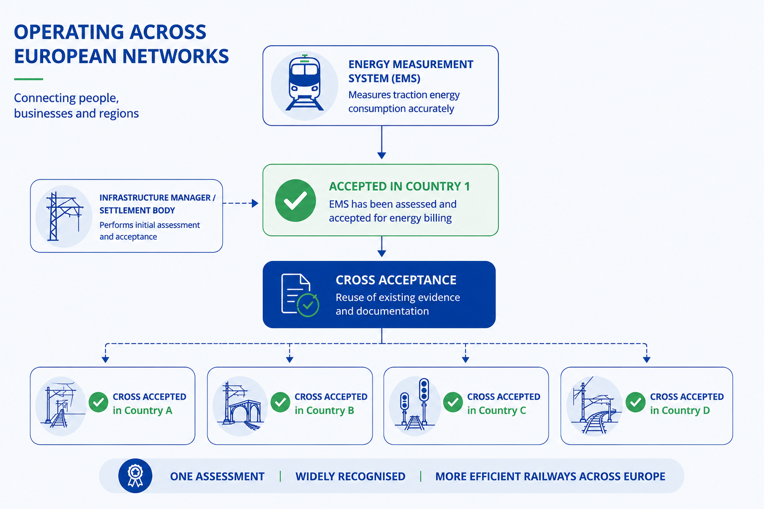
An Energy Measurement System (EMS) provides the accurate data used for energy settlement and billing. Yet, despite existing standards and approvals, operators may still face repeated acceptance procedures when entering new countries.
This creates unnecessary administrative work, increased costs, and delays for Railway Undertakings and Vehicle Keepers.
What is Cross Acceptance?
Cross Acceptance is based on a simple principle: if an EMS has already been assessed and accepted in one country, that should be evidence when seeking acceptance in another country.
By using a common documentation package, infrastructure managers can reduce duplication while maintaining confidence in the quality and accuracy of energy measurement data.
Key Benefits
Cross Acceptance helps creating a more efficient process for everyone involved.
It reduces administrative burdens, and provides
- Less duplicate testing
- Faster acceptance processes
- Lower costs for train Operators and Vehicle Keepers
- Greater consistency among countries
Supporting a More Connected Railway Network
As international rail traffic continues to grow, simplifying the acceptance of already verified Energy Measurement Systems becomes increasingly important.
By reducing complexity and encouraging cooperation, Cross Acceptance supports the wider
European goal of a more interoperable, efficient, and sustainable railway sector.
Eress technical experts have developed this Cross Acceptance Guide to simplify the reuse of approved Energy Measurement Systems (EMS) across European railways.